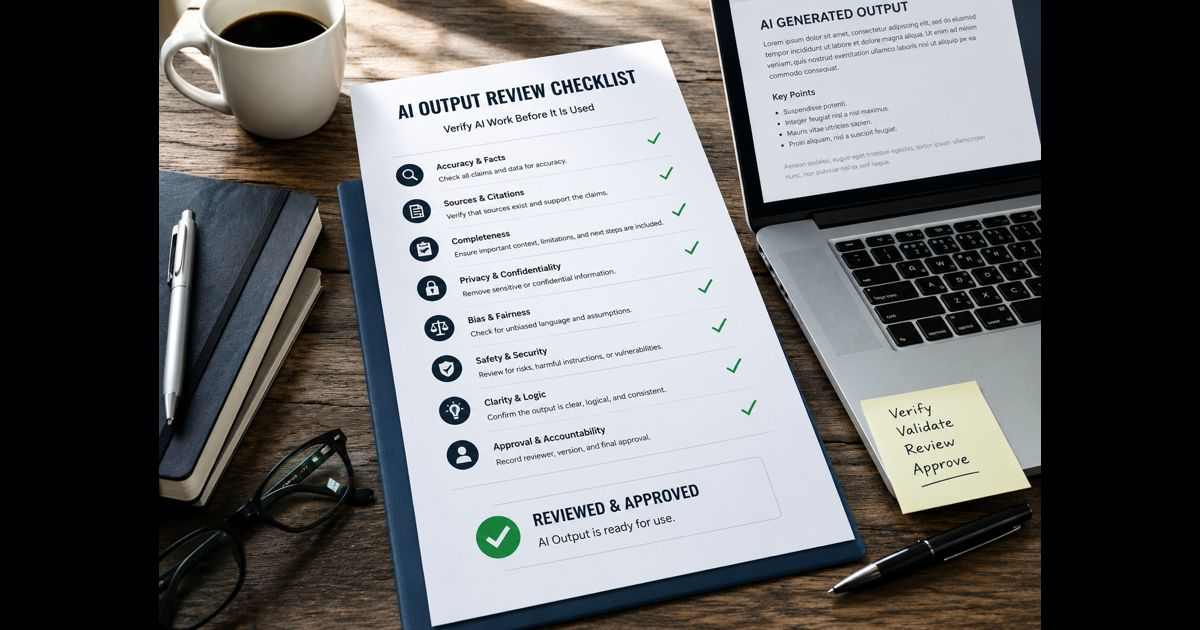
AI output review is the discipline of deciding whether an AI-generated draft, answer, summary, analysis, image description, code suggestion, or recommendation is fit to use. It is not a quick spelling check at the end of a workflow. It is the point where a person confirms what is true, what is missing, what could cause harm, and who is accountable for the final result.
A polished response can still contain an invented source, a wrong date, a misleading comparison, an unsafe instruction, or confidential information that should never leave an internal system. Fluency is not evidence. The more confidently an output will influence a customer, colleague, decision, payment, publication, or system, the more deliberate the review must be.
This AI output review checklist gives teams and individual users a repeatable way to review work before it is published, shared, submitted, or acted upon.
Start With the Decision, Not the Draft
Before reviewing individual sentences, establish what the output will be used for. A product description, meeting summary, customer reply, internal brainstorm, legal analysis, medical explanation, financial recommendation, and software deployment do not deserve the same review depth.
The reviewer should be able to answer five questions:
- What decision, action, or communication will this output support?
- Who could be affected if it is wrong, incomplete, unfair, or exposed?
- What is the consequence of an error?
- Which claims require independent evidence?
- Who has authority to approve the final version?
A low-risk internal outline may only need a practical accuracy and clarity review. A public statement, hiring recommendation, customer-facing answer, compliance document, payment instruction, or production code needs stricter checks and a named approver.
Risk is shaped by impact, not by length. A short AI-generated sentence approving a refund or describing a safety procedure can matter more than a long, low-stakes brainstorm.
AI Output Review Checklist
Use the following checklist in order. If a critical issue cannot be resolved, do not publish or use the output. Return to the source material, revise the prompt, obtain expert review, or remove the unsupported section.
|
Review area |
Questions to answer before approval |
Stop and escalate when |
|
Purpose |
Does the output answer the assigned task and stay within its allowed role? |
It makes decisions, promises, or recommendations beyond its authority. |
|
Facts |
Is every material claim accurate, current, and supported by reliable evidence? |
A claim cannot be verified or conflicts with a primary source. |
|
Sources |
Do cited sources exist, say what the output claims, and remain current? |
A citation is fabricated, irrelevant, inaccessible, or outdated. |
|
Completeness |
Are key conditions, exceptions, limitations, and next steps included? |
Missing context could materially change a reader’s decision. |
|
Logic and calculations |
Do reasoning steps, dates, units, totals, and assumptions hold up? |
A calculation, comparison, or conclusion cannot be reproduced. |
|
Privacy |
Does it reveal personal, client, employee, financial, or confidential information? |
Sensitive information appears without clear authorization. |
|
Fairness |
Does the language make unsupported assumptions about people or groups? |
It could discriminate, stigmatize, or create unequal treatment. |
|
Safety and security |
Could it enable harm, unsafe behavior, fraud, data exposure, or insecure system changes? |
The output contains a high-impact instruction without expert validation. |
|
Rights and attribution |
Are quotations, creative material, images, and claims handled lawfully and accurately? |
It presents protected material as original or omits required attribution. |
|
Clarity |
Is it understandable, appropriately qualified, and free from false certainty? |
A reasonable reader could misunderstand what is known or unknown. |
|
Approval record |
Is the reviewer, version, evidence, and final decision recorded where needed? |
No accountable owner is willing to approve the outcome. |
1. Confirm That the Output Matches the Assigned Task
The first review is about relevance and boundaries. AI often produces useful-looking extra material that was not requested, including recommendations, assumptions, invented background, or policy statements. Extra content is not harmless when it changes the scope of a decision.
Compare the output with the original assignment and identify:
- The intended audience
- The required format
- Facts or documents the output was allowed to use
- Information it was not authorized to infer
- Any mandatory policy, style, legal, or accessibility requirements
- The action the reader is expected to take
For example, a meeting summary should distinguish decisions from suggestions and unresolved points. A customer-service response should not promise a remedy that the organization has not approved. A research summary should not convert a limited finding into a universal conclusion.
Remove material that is outside the assignment, even if it sounds useful. A focused, defensible answer is stronger than a broad answer that quietly introduces risk.
2. Verify Every Material Fact Independently
Check claims that could alter a reader’s understanding, decision, money, safety, rights, or reputation. This includes names, dates, prices, statistics, product capabilities, legal rules, study findings, policy requirements, and statements about what another person or organization did.
Verification should rely on the best available source for the claim. A primary document, official record, original dataset, contract, current policy, or direct subject-matter confirmation is usually more reliable than an AI-generated explanation or a copied secondary summary.
Pay particular attention to these warning signs:
- Exact figures with no traceable source
- Confident claims about recent events
- Named studies, cases, regulations, standards, or quotations
- “Always,” “never,” “guaranteed,” and similarly absolute language
- Comparisons that do not define the measure being compared
- Recommendations presented as facts
- Details that sound plausible but are unusually specific
Do not assume that a correct opening paragraph makes the rest trustworthy. Review each material claim on its own evidence.
3. Check Sources, Citations, and Quotations Line by Line
AI systems can invent citations, combine details from different sources, attach a real link to the wrong claim, or quote text that does not appear in the original. A citation is not proof until a reviewer opens it and confirms the connection.
For each source or quotation, verify:
- The source exists and is accessible
- The author, publisher, title, and date are correct
- The source supports the precise claim beside it
- The source has not been superseded by newer information
- The quoted wording is accurate and not taken out of context
- A more authoritative original source is available when the point is important
A source can be genuine and still fail the review. For instance, an old announcement may no longer reflect current pricing, a news report may not establish a legal requirement, and a vendor’s own marketing page may not prove a comparative performance claim.
When evidence is weak or mixed, revise the language to describe the uncertainty accurately. If the claim cannot be supported, remove it.
4. Test Reasoning, Dates, and Calculations
AI can arrive at a sensible conclusion through incorrect steps. This is especially important in budget planning, reporting, engineering, research, scheduling, software, and any work involving dates or quantities.
Recalculate totals independently. Check units, decimal places, currencies, time zones, percentage bases, rounding methods, and whether figures refer to the same period. Ask whether the conclusion would still hold if a central assumption changed.
For reasoning-based outputs, identify:
- The evidence used
- The assumptions made
- The rule or method applied
- The conclusion reached
- Any plausible alternative explanation
If the steps cannot be reconstructed, the conclusion should not be treated as reliable. A review is not complete because the final answer sounds logical; it is complete when a qualified person can follow and defend the path to that answer.
5. Look for Missing Context and False Certainty
Many AI errors are omissions rather than outright falsehoods. An answer may present one option without mentioning an important exception, limitation, dependency, cost, eligibility rule, or uncertainty.
Read the output from the perspective of the person who will rely on it. Ask:
- What would a reasonable reader need to know before acting?
- Which conditions make this advice inapplicable?
- Are probabilities being presented as certainties?
- Does the conclusion depend on facts that have not been established?
- Has the output confused correlation with cause?
- Does it acknowledge meaningful trade-offs?
Good review often means adding less, not more. A concise qualification can prevent a harmful misunderstanding. For example, a recommendation may need a clear boundary such as “subject to current policy,” “requires professional confirmation,” or “based only on the supplied records.” Use qualification when it is true and useful, not as a vague disclaimer that hides weak work.
6. Inspect for Privacy, Confidentiality, and Data Exposure
Review both what was entered into the AI system and what appears in the output. Confidential information can be exposed through direct identifiers, combinations of details, hidden metadata, copied source text, attachments, or summaries that reveal more than intended.
Check for:
- Names, addresses, phone numbers, account details, or identity documents
- Health, employment, education, legal, or financial information
- Client information, internal strategy, source code, credentials, or contract terms
- Personal details that make someone identifiable in a small group
- Data from a document that was not authorized for wider sharing
- System prompts, internal instructions, API keys, or security architecture
Redact sensitive details before sharing the output beyond its approved audience. If the output is based on confidential material, confirm that the selected AI tool, access settings, retention terms, and internal policy permit that use. A useful result does not justify an unauthorized disclosure.
7. Check for Bias, Exclusion, and Unjustified Assumptions
Bias review is not limited to offensive words. It also includes apparently neutral language that assumes ability, behavior, credibility, competence, risk, or suitability based on a person’s identity or group membership.
Review examples, descriptions, rankings, hiring language, customer segmentation, and recommendations for unsupported generalizations. Check whether the output treats different people consistently and whether it omits a relevant group, barrier, or perspective.
A practical test is to replace a demographic detail with another one. If the recommendation or tone changes without a justified reason, the output needs review.
When the task involves people, especially employment, housing, education, lending, insurance, healthcare, public services, or discipline, use stronger safeguards. Ensure a qualified human reviews the output against the applicable policy and evidence rather than allowing a generalized model response to determine an individual outcome.
8. Review Safety, Security, and Actionability
Some outputs are informative until someone acts on them. Code, configuration steps, security guidance, operating procedures, medical content, financial instructions, and legal analysis require a review that considers real-world consequences.
Check whether the output:
- Gives instructions that could damage systems, records, equipment, or property
- Weakens access controls, validation, logging, or approval safeguards
- Includes insecure code, hard-coded secrets, unsafe commands, or unvalidated inputs
- Encourages a person to delay urgent professional help
- Provides directions that could cause injury or enable wrongdoing
- Tells readers to override established policy or expert judgment
For technical work, test in an isolated environment and review the changes rather than copying code directly into production. For high-impact domains, AI should assist research, drafting, or explanation; final decisions and instructions should remain with appropriately qualified people.
9. Confirm Rights, Attribution, and Provenance
AI-assisted work can blur the origin of text, imagery, code, data, and quotations. Reviewers should confirm that the final work does not present someone else’s protected material as original, reproduce a quotation inaccurately, or make an unsupported ownership claim.
Check that:
- Quotes are attributed accurately
- Images and creative assets have appropriate rights or permissions
- Third-party code complies with its license and security requirements
- The output does not imitate a living creator in a misleading way
- Any required disclosure about AI assistance is made according to the relevant policy
- The team can explain where critical facts and assets came from
For content work, originality is not just a plagiarism check. It also means the final piece demonstrates editorial judgment, clear structure, accurate context, and a perspective that has been genuinely developed for the reader. AI can help organize notes and identify gaps, but it should not be treated as a source of truth, as explained in Content Creation Sparkpressfusion Com.
10. Edit for Clarity, Tone, and Honest Confidence
The final review is where the work becomes usable. Correct grammar and formatting, but also examine whether the wording is proportionate to the evidence.
Replace vague authority with specific explanation. Remove repetitive filler. Define technical language when the audience needs it. Make instructions sequential where sequence matters. Separate confirmed facts from estimates, interpretation, and recommendations.
Watch for common signs of machine-like overconfidence:
- Overly smooth transitions that conceal a weak connection
- Generic conclusions that repeat earlier points
- Long lists with no prioritization
- Claims of completeness without evidence
- Excessive headings that fragment the explanation
- A confident recommendation with no stated basis
The aim is not to make the writing sound less like AI. The aim is to make it clear, accountable, and useful to the person reading it.
Assign an Approval Level Before Release
A checklist works best when the required review level is set before work begins. Teams can use a simple three-level model.
Level 1: Low-impact internal work
Examples include brainstorms, rough outlines, non-sensitive note organization, and early drafts. The creator checks relevance, obvious errors, privacy, and clarity before sharing internally.
Level 2: Routine operational or public-facing work
Examples include published articles, customer communication, internal procedures, marketing copy, and reporting. A knowledgeable reviewer verifies material facts, sources, brand or policy alignment, and final wording.
Level 3: High-impact work
Examples include legal, financial, medical, safety-critical, security-sensitive, employment, or regulated decisions. The work requires qualified review, documented evidence, and an explicit release decision. AI output must never be the sole basis for the action.
The level can change as work evolves. A routine summary becomes high-impact when it is used to approve a payment, evaluate a person, advise a customer, or change a live system.
Record the Review Where Accountability Matters
For recurring or high-impact uses, keep a short review record. It does not need to be bureaucratic. A useful record includes the task, model or tool used, input sources, reviewer, checks completed, material changes, unresolved limitations, approval decision, and date.
This record helps teams spot patterns. Repeated source errors may show that prompts need better evidence boundaries. Repeated privacy issues may show that a tool or workflow is unsuitable. Repeated edits in one section may reveal a training gap or an unclear policy.
Review should improve the process, not merely catch one bad output at a time.
A Final Release Test
Before using the output, ask one final question:
Would a qualified reviewer be comfortable explaining and defending this result to the person affected by it?
If the answer is no, the output is not ready. Revise it, verify it, narrow its scope, or keep it as a draft. The value of AI is not that it removes human responsibility. Its value is that it can speed up useful work when people retain judgment over what is true, safe, fair, and fit to use.
Frequently Asked Questions
Is an AI detector part of an AI output review checklist?
No. AI detectors do not verify factual accuracy, source quality, privacy, bias, logic, or safety. A strong review examines the substance and consequences of the output rather than trying to guess how it was produced.
Should every AI-generated draft be reviewed by a human?
Yes, when the draft will be shared, published, used in a decision, or relied upon for meaningful work. The level of review should match the possible impact. Low-risk internal material may need a quick check; high-impact work needs qualified, documented review.
What is the most important AI output review step?
Verify material claims against reliable evidence. An output can be well written and still be harmful if its central facts, sources, calculations, or recommendations are wrong.
Can an AI output be approved if some details cannot be verified?
Only if the unverified detail is removed or clearly identified as uncertain and does not materially affect the intended use. Unsupported claims should never be presented as established fact.
Who is responsible for an AI-assisted result?
The person or organization that uses, publishes, approves, or acts on it remains responsible. AI can assist the workflow, but it cannot hold accountability for the outcome.