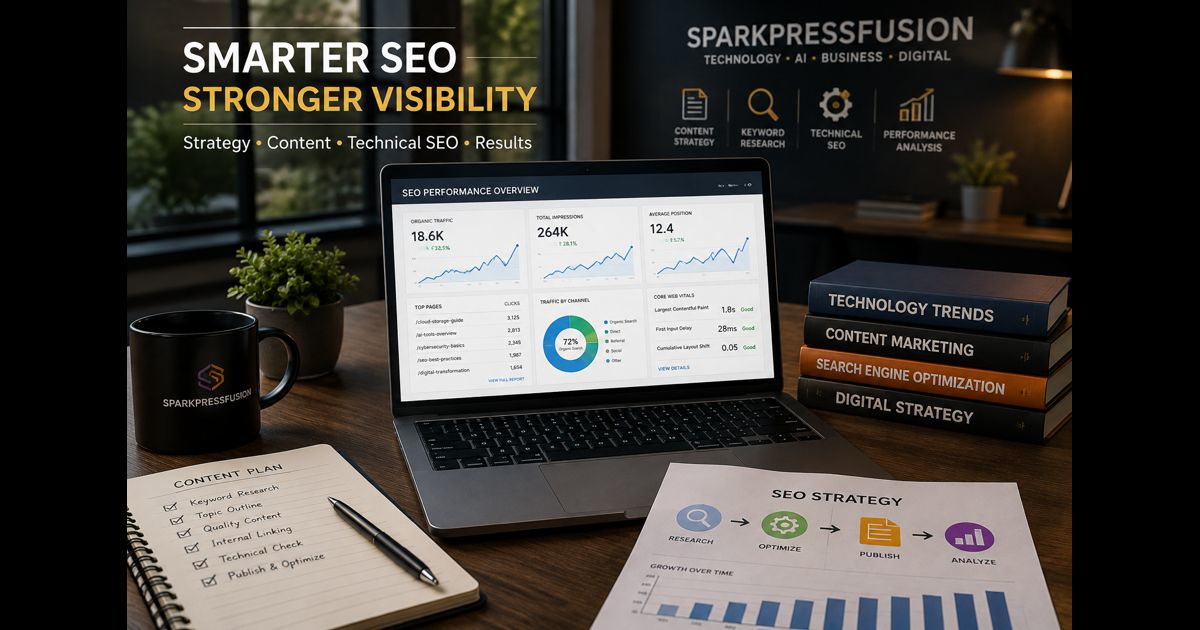
SEO optimization SparkPressFusion Com refers to the work of making a website’s useful pages easier for Google and other discovery systems to access, understand, and present to the right readers. It is not a promise of a particular ranking, instant traffic, or a substitute for good editorial judgment.
SparkPressFusion covers technology, artificial intelligence, business, cybersecurity, content, and digital communication. Within that scope, optimization should support clear, accurate publishing rather than turn articles into repetitive sales copy. A page earns attention when it answers a real question well, provides context that competing pages miss, and remains easy to use on any device.
The site’s own editorial position connects content, SEO, brand communication, and digital visibility as related disciplines. That is a sensible foundation: visibility can bring a reader to a page, but usefulness determines whether the visit has value.
Start With a Clear Page Purpose
Every strong page should have one central job. It may explain a technical issue, compare two approaches, clarify a business concept, or help a reader assess a digital claim. When a page attempts to cover too many unrelated ideas, its structure becomes weak and its value becomes unclear.
Before writing, define:
- The practical question the page can answer
- The reader’s likely level of knowledge
- The facts, limits, and examples needed for a complete explanation
- The related SparkPressFusion page that genuinely adds depth
A useful article does not need to cover every possible angle. It needs to cover its chosen subject thoroughly enough that the reader does not leave with unanswered basics or a misleading conclusion.
For example, an article about cloud storage should explain the difference between storage capacity, security, access controls, recovery, cost, and vendor responsibility. Naming a few platforms without explaining these decisions would leave the reader with an incomplete picture.
Make the Main Information Easy to Find
A page should communicate its subject before a reader reaches the middle of the article. A descriptive title, a direct opening, and focused headings help people decide whether the page is relevant.
Good structure is not about filling a page with headings. It is about giving each section a distinct purpose:
- Define the subject in plain language
- Explain the parts that affect a decision or outcome
- Address important exceptions and limitations
- Give practical next steps where they are appropriate
- Close with a conclusion that follows from the evidence
Long paragraphs often hide the most useful information. Shorter sections, carefully chosen subheadings, examples, and tables can make a complex topic easier to evaluate without reducing it to shallow advice.
This approach also suits SparkPressFusion’s broader aim of making digital subjects understandable without stripping away the context that makes them accurate. Readers looking for a wider view can explore the site’s discussion of content, SEO, brand communication, and digital visibility.
Prioritize Original Information Over Familiar Advice
Many SEO articles repeat the same advice: add headings, write a title, use links, and improve speed. Those actions can help, but repetition alone does not make a page worth reading.
The stronger approach is to add information that could not simply be copied from a generic checklist. Depending on the subject, that may include:
- A careful explanation of a common misunderstanding
- A comparison of options using meaningful criteria
- A step-by-step decision framework
- Current documentation from a reliable primary source
- Clear boundaries around what is verified and what remains uncertain
- Examples showing how a recommendation changes in different situations
This is particularly important for technology, AI, finance, legal matters, health, privacy, and security. Readers need more than confident wording. They need to know what is established, what may vary, and when professional or official guidance is necessary.
Google’s people-first guidance supports this direction: pages should help readers rather than exist primarily to influence rankings.
Strengthen Technical Foundations
Editorial quality cannot fully compensate for a page that crawlers or readers cannot access properly. Basic technical checks should be completed before expecting consistent visibility.
A well-maintained page should have:
- A unique, descriptive URL
- One preferred canonical version
- A readable title and meta description
- Mobile-friendly layout and readable text
- Secure HTTPS delivery
- Working internal links and no unnecessary redirect chains
- Images with meaningful alt text where the image adds information
- Crawlable links between important pages
- A sitemap that includes pages intended for indexing
Performance also deserves attention. A slow, unstable, or visually disruptive page can frustrate visitors even when its writing is excellent. Google evaluates page experience through several factors, including Core Web Vitals, mobile display, HTTPS, intrusive interstitials, and the overall usability of the page.
Do not treat technical scores as a race for perfection. The practical goal is a page that loads reliably, stays readable, and allows visitors to reach the information without friction.
Use Titles and Descriptions That Match the Page
A title should identify the page’s actual subject, not make an exaggerated promise. The description should explain the benefit of reading it without repeating the title word for word.
For a technology article, specificity is more convincing than vague claims. “How to assess cloud-storage security before choosing a provider” tells a reader far more than “The ultimate cloud guide.”
The page itself must deliver what its title suggests. If the opening promises a factual review, it should show verified information, source limitations, and an honest conclusion. A mismatch between title and content may earn a click once, but it does not create trust.
Build Internal Links for Readers First
Internal links are useful when they take a reader to the next logical piece of information. They should not be placed merely because a page needs more links.
A piece about optimization may naturally lead to a broader modern content marketing strategy, because publishing quality and distribution choices affect one another. A cybersecurity article may lead to a related privacy guide. A business article may lead to a deeper explanation of AI adoption or digital transformation.
The anchor text should describe the destination naturally. Reusing the same exact wording across every article makes the site feel mechanical and provides little reader value.
Prepare for AI Answers Without Chasing Shortcuts
AI Overviews, AI Mode, answer engines, and large-language-model tools can surface pages that already provide clear, reliable, accessible information. They do not require a secret format.
The practical requirements remain familiar:
- Publish information that is accurate and distinct
- Use clear language and logical structure
- Keep factual claims current
- Cite authoritative sources for significant claims
- Make pages publicly accessible and technically understandable
- Use relevant images or video when they genuinely improve the explanation
- Keep author, publication, and update details transparent where appropriate
Avoid creating thin pages for every slight wording variation. Avoid artificial mentions, fabricated expertise, and special files claimed to guarantee AI visibility. Google states that strong standard SEO practices remain the foundation for inclusion in its generative features, while content created at scale without added value can violate spam policies.
Measure Outcomes, Then Improve the Right Page
Optimization should be measured through evidence, not assumptions. Google Search Console can show impressions, visits, pages that are indexed, technical issues, and changes over time. Analytics can show whether visitors continue reading, use internal links, or leave immediately.
When a page underperforms, diagnose the cause before rewriting it. The issue may be unclear scope, dated information, weak structure, missing technical access, an uncompetitive title, or a topic that needs more firsthand insight.
Updates should improve substance. Add missing facts, correct outdated claims, clarify confusing sections, and remove material that no longer serves the article. Changing sentences only to make them look new does not create a better resource.
Final Thoughts
SEO optimization SparkPressFusion Com is most effective when it protects the quality of the publication instead of chasing shortcuts. Clear purpose, original analysis, technically accessible pages, honest titles, natural internal links, and regular factual updates create a stronger foundation than inflated claims or repetitive formatting.
The goal is not to force a ranking. It is to publish the page that best deserves to be found when a reader needs a clear, reliable explanation.